
Sultanpur National Park Earth Walks: A Nature Retreat Near Delhi
Date: 15 February 2026
Location: Sultanpur National Park
Location map: https://maps.app.goo.gl/9sQZbj5aVdryukFP8
Walk leader: Arnav Gupta
Walk Theme: Birds of Sultanpur: Great Backyard Bird Count Walk
Walk Coordinator: Salil Dutta
No. of participants: 57
Sultanpur National Park is one of those rare urban biodiversity hotspots that has efficiently survived the test of time. To highlight and divert the attention of nature enthusiasts towards it, Asian Adventures, along with Global Wildlife Fair, organised an Earth Walk here. This walk was also organised to commemorate the Great Backyard Bird Count. The students from the Indian Institute of Tourism and Travel Management, Noida, were also a part of this walk. The walk began with the walk leader throwing light on the past of the place. This place was first noticed by Peter Jackson and Dr Salim Ali. It was by him for the first time in 1970 that the plea for the Sultanpur Jheel to be recognised as an established bird sanctuary was raised. He directly brought the matter to the notice of the then prime minister, Ms Indira Gandhi.

She herself wanted to visit the sanctuary, but that could not happen until the CM of Haryana, Bansi Lal, surveyed the place on her orders, and it was declared a bird sanctuary in 1972. The walk leader further explained that it was in the year 1990 that it was upgraded to the position of a national park. Hence, it can be seen as one of those rare spots that brings the divergent streams of biodiversity and politics into one frame. Right towards the beginning of the walk, a gray-throated Martin was spotted. It was then explained how this area, which is spread over 142.25 hectares, witnessed about 250 species of birds every year. It is even a major stopping point for migratory birds.

It was then that the bird-watching adventure began. A distant call of a bird was heard from somewhere in the trees, but somehow it was so disguised amongst the thick canopy that it couldn't be traced. After almost searching for it for 10 minutes straight with the help of cameras and binoculars, an oriental magpie was seen hidden amongst the trees. The purple sunbird became the next topic of discussion as it crossed the sky and caught the attention of the participants. Its mating time, general behavioural patterns and food preferences were asked by the curious birders, which were duly answered by him. An interesting fact was shared by him at this point that Sultanpur is also symbolic of the country’s commitment towards wetland protection, as it was declared a Ramsar site in the year 2021. It is the first Ramsar site in Haryana. A red-breasted flycatcher became a centre of attraction for the birders as it had perfectly positioned itself between the leaves and seemed settled comfortably within nature’s frame.
Sultanpur is not only a key biodiversity hotspot in its own right, but it is also part of a major birding corridor for resident and migratory birds, along with the Najafgarh and Bhindawas wetlands. Since the walk was organised on the occasion of the Great Backyard Bird Count, all participants had their eBird and Merlin apps ready, and they were recording and identifying the birds present in their surroundings. The highlight of the walk became the sighting of the rare White-tailed Eagle. This avian wonder was truly a mesmerising sight; the walk was an immense success, with participants thoroughly enjoying the collective activity of tracing and recognising birds. The various birding experiences that were shared were the add-ons to the overall enriching natural experience.
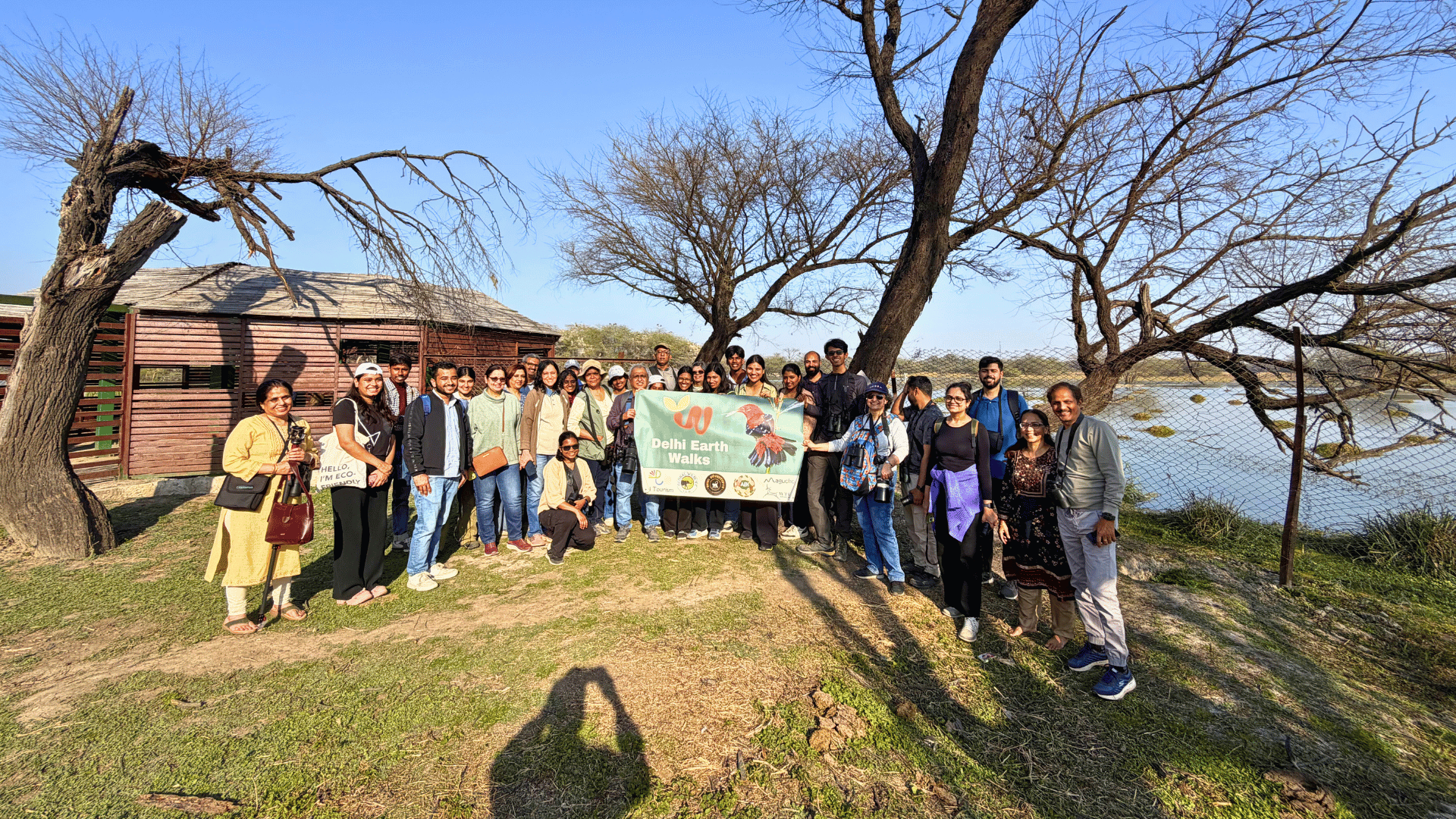
You can even add avian highlights to your Sundays and explore urban biodiversity gems through a whole new experience with Earth Walks. Suspend in nature, gain new insights, and realise the link between you and ecology with Earth Walks. To be a part, Click here https://asianadventures.info/p/af0725/
Bird List
- Graylag Goose
- Northern Shoveler
- Gadwall
- Eurasian Wigeon
- Indian Spot-billed Duck
- Northern Pintail
- Green-winged Teal
- Common Pochard
- Indian Peafowl
- Rock Pigeon
- Eurasian Collared-Dove
- Laughing Dove
- Yellow-footed Green-pigeon
- Greater Coucal
- Eurasian Moorhen
- Eurasian Coot
- Gray-headed Swamphen
- Black-winged Stilt
- Red-wattled lapwing
- White-tailed lapwing
- Wood Sandpiper
- River Tern
- Little Grebe
- Black-necked stork
- Painted Stork
- Oriental Darter
- Little Cormorant
- Greater Cormorant
- Glossy Ibis
- Black-headed Ibis
- Red-naped Ibis
- Little Egret
- Indian Pond-Heron
- Eastern Cattle-Egret
- Great Egret
- Gray Heron
- Purple Heron
- Greater Spotted Eagle
- Western Marsh Harrier
- Black Kite
- White-tailed Eagle
- Indian Scops-owl
- Spotted Owl
- Indian Gray Hornbill
- White-throated kingfisher
- Coppersmith Barbet
- Brown-headed Barbet
- Alexandrine Parakeet
- Rose-ringed Parakeet
- Black Drongo
- Rufous Treepie
- House Crow
- Common Tailorbird
- Ashy Prinia
- Plain Prinia
- Gray-throated Martin
- Barn Swallow
- Red-vented Bulbul
- Hume’s warbler
- Common chiffchaff
- Greenish warbler
- Lesser whitethroat
- Indian white-eye
- Jungle Babbler
- Common Myna
- Oriental-Magpie Robin
- Red-breasted Flycatcher
- Purple Sunbird
- Western Yellow-wagtail
- Citrine Wagtail