
Maharashtra Nature Park Nature Walk: Discovering Trees and Butterflies
Discovering the environs of Mumbai - A report on the Mumbai Earth Walks nature trail
Date: 04 Oct 2026
Location: Maharashtra Nature Park
Walk Theme: Nature Walk
Walk Leader: Renee Vyas
Walk Coordinator: Nita Deb
No. of participants: 48
Asian Adventures, Global Wildlife Fair and Sanctuary Asia collaborated to organise an Earth Walk in Maharashtra Nature Park. Participants had gathered before we arrived, some from as far as Nalasopara and Ambarnath. We began with an introduction to Asian Adventures and our relatively new initiative in Bombay: the Mumbai Earth Walks, which aimed to help citizens learn about the flora and fauna of the city they live in and its ecology and environment. From this moment itself, we realised that today we had a group of people who were very interested in nature, and we knew it was going to be a great day.

The walk leader began her introduction. Having conducted over 300 free tree walks in the city, she is fluent in reaching the hearts of people, often reiterating that all she wanted was someone willing to listen, and she would take hold of them, take them into a forest or garden, and convert them into a tree lover. From her ever-present Santa Claus bags of samples, gifts, show-and-tell items and explanatory diagrams she always carries on walks, she pulled out a box of seeds, gifting the 3 children present (Buggi, Naira and Vaani) a Common Rattle-Pod (Crotalaria retusa, khudkhuda in Marathi) seed pod each, which she asked them to shake and make some noise. They were delighted. This shrub’s flowers are favoured by carpenter bees. The bruised and dried seed plant is very attractive to milkweed butterflies like the Tiger
and Common Crow, as it contains an alkaloid essential for their reproduction.

She then asked us to look up. We were standing under a tall kadamb (Neolamnaea cadamba), with its ripe fruit hanging on the branches and strewn over the ground. She told us how, as kids, they used to eat the ripe fruit. She showed us the flowers, individually tiny, deep yellow or orange, clustered together in round heads about the size of a large Chikoo. Fruit retain the shape of round flower heads, turning a more sombre shade of orange when mature, and split open, releasing the seeds to be dispersed by wind and rain.
A little ahead, she showed us the kadam (Mitragyna parvifolia). This is the true Kadam which is associated with Lord Krishna in Vrindavan. The flowers of this kadam are also tiny pale yellow, clustered in spherical heads about 2.5 cm in diameter. Unlike the other Kadamba, however, the fruit is not edible, but the stem, bark and leaves are used in various traditional medicines.

Moving on, we were encouraged to pick up, from the ground, the seeds and seed pods of the Ratan Gunj, and adults and kids were kept busy. There is a deep spiritual connection between Ratan Gunj (Adenanthera pavonina) and the famous
Guruvayur Sree Krishna Temple in Thrissur, Kerala. A massive, heavy-bottomed brass vessel filled to the brim with thousands of these bright red seeds is placed right near the entrance of the sanctum sanctorum. Devotees scoop up handfuls of the smooth, cool seeds and put them back into the vessel, repeating this action three times, signifying emptying one’s ego and surrendering to the divine.

She pointed to a tree that seemed to have pine cones and pine-like needles. "Where do you usually see this tree?" she asked. Almost all said, "In the mountains!" She grinned and explained that though it looked like a Pine, it was not a conifer at all. It is a Casuarina tree, locally known as "Suru", and it is planted on many beaches in Maharashtra as a windbreak. Its "pine cones" are woody, cone-like fruit containing winged seeds. Its jointed branchlets help in photosynthesis, and the leaves are arranged in whorls around the branchlets, reduced to the size of tiny scales to help minimise transpiration. The male flowers are borne in slender cylindrical spikes at the twig tips. The tiny brownish-red female flowers grow in heads attached to the branchlets and are followed by 0.5 in diameter fruits that resemble pinecones and contain 70-90 winged seeds each. Because I am a camper, I also know the branchlets make excellent kindling for a campfire.
We walked past Jamaican Spike and many butterflies fluttering by. The Spot of the Walk went to Renee, who spotted 2 tiny butterflies mating on a nearby shrub. We moved ahead to the Awla tree, whose fruit has one of the highest concentrations of Vitamin C, and is therefore a strong antioxidant and used in many medicinal and cosmetic products. The best part is, the Vitamin remains potent even when cooked. Of course, it is not yet its season, and the tree was bare of fruit.

The most iconic story about trees that Renee tells is the one about the Strychnos nux-vomica. Its seeds are used in Ayurvedic medicine and as a heart tonic. However, the seeds are highly poisonous. It is a poison that produces dramatic and painful symptoms of any known toxic reaction and was the modus operandi in Agatha Christie's first murder mystery, "The Mysterious Affair at Styles", published in 1920 - almost 140 years ago- in which a woman murders her husband. Renee always carries a copy of this book to show participants in her walks, joking about how she has been happily married for 43 years but sometimes in between has felt like using strychnine... Definitely a popular tree with the ladies.
Renee led us to the one Ficus arnottiana growing on a Ficus amplissima - which is not commonly seen. There are about 800 to 850 species of Ficus found around the world (except in North America and Europe). Each species has its own pollinator wasp, and the flowers are in the fig. She explained, the “love story of the Wasp and the Fig”. Ficus are known as Keystone species, as they create a balance in the forest just as the tiger is a keystone species. They are on top of the food chain, and if they go, everything around them crumbles.
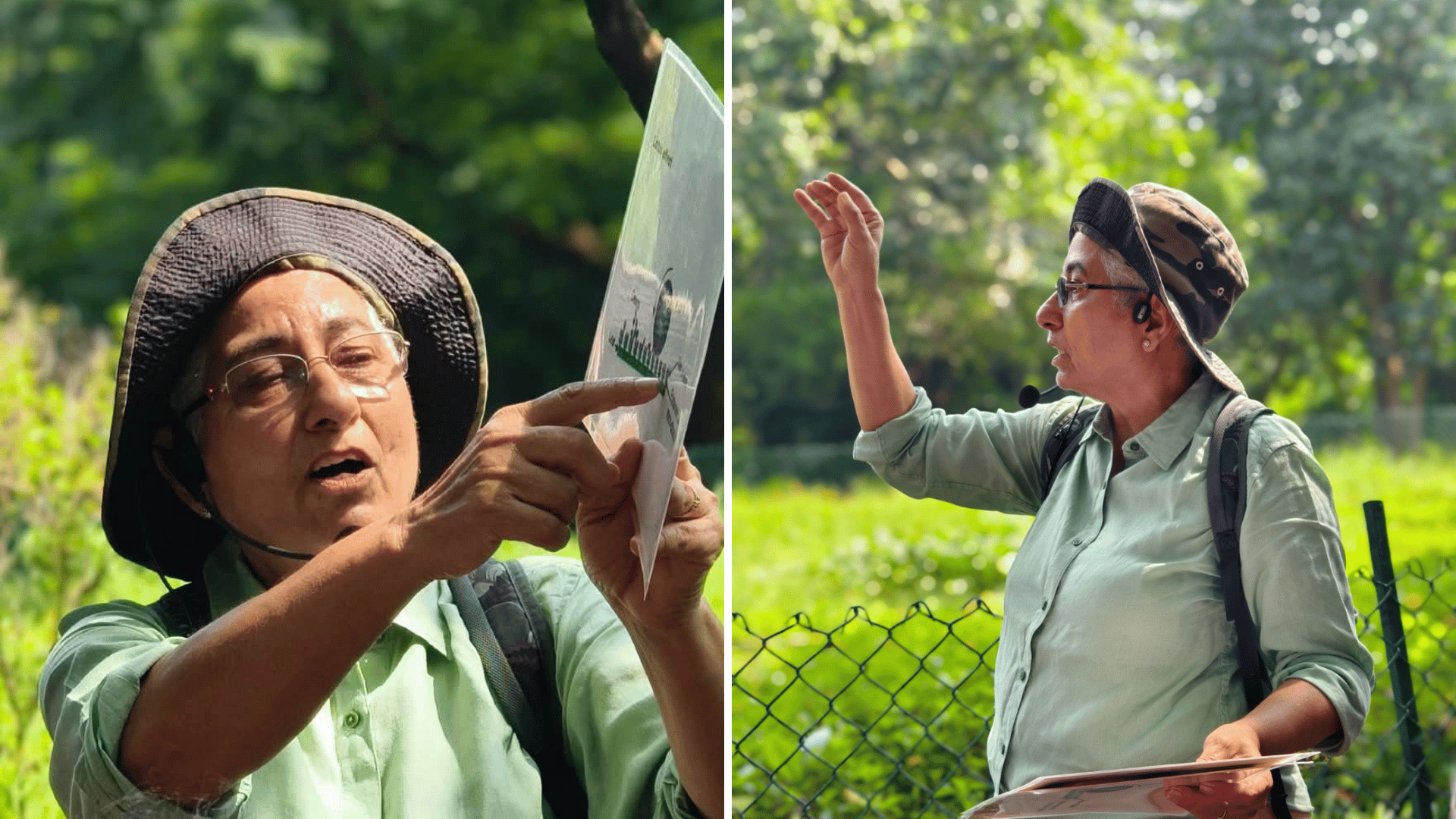
Right in front of this is the pond with both water lilies and lotus plants. There was only one Water Lily flowering, but Renee had brought her own Lotus for show and tell. She told us about the Lotus Effect - a self-cleaning behaviour where water droplets roll off the surface of the lotus leaves, carrying any dirt with it. So how can you tell the difference between the two? The main difference is that water lilies float on the surface of the water, while a lotus rises above the water on tall stems. And you can tell the difference easily from the leaves, she said, grinning widely. The water lily is a little naughty - it has a slit in its skirt! Everyone laughed at that, and a lady remarked, "Now we can never forget that"! We walked around the garden, spotting centipedes, Shoaib hosting a praying mantis on his sleeve, some of those young-at-heart climbing on the Ficus on Ficus coalition.
It was getting really hot, and attention was flagging a bit, so our dear Renee began an impromptu song and dance celebrating nature, and asked us to join in. "Ek tha mota pahaad, uspe bohot se pedh, pedh
pe ghosle, ghosle mein chidiya, aur bohot saare pakshi - aur?? hariyali idhar udhar, hariyali idhar udhar!" Everyone sang and danced, got refreshed and re-activated! We moved ahead to see the passion flower creeper, one lone bloom attracting a huge number of clicks. And then Renee got us walking barefoot in the park! She urged us to remove our shoes and socks and walk in the Love Grass (Eragrostis unioloides), so called because when the British ladies walked with their long skirts on this grass, it tickled their ankles. It was enjoyable and also healing to feel the naked grass under our feet.
For the grand finale, she brought everyone under the magnificent Ficus amplissima, which occupies a prime spot next to the lawn. This is a Keystone species, which she had hinted at earlier, and now, under its spreading shade, she spoke passionately about how much effort these trees take to survive and create a healthy environment for all the living beings on this beautiful planet Earth. Banyan, pipal, Ambar - commonly seen Ficus in our cities - are often thought of as being “of no use to humans” as they do not provide any fruit, their wood cannot be used for anything, and they don’t have medicinal properties … but still they are declared as Keystone species. Why? Because under harsh conditions like natural calamities, fire, and floods, they never die…and so, over a period, help regenerate the forest. They grow back even if a small root is still there in the soil, providing shelter to birds, insects, and animals. Birds and animals eat the figs and spread the seeds, and also bring seeds of other plants from far-off places, and slowly the forest comes back. How important it is to save them from the greed of human beings; they are declared sacred by our ancient elders, and we would be wise to protect them. We mulled on this, looking at the Ficus that grows on building walls and cracks in the road with new respect.
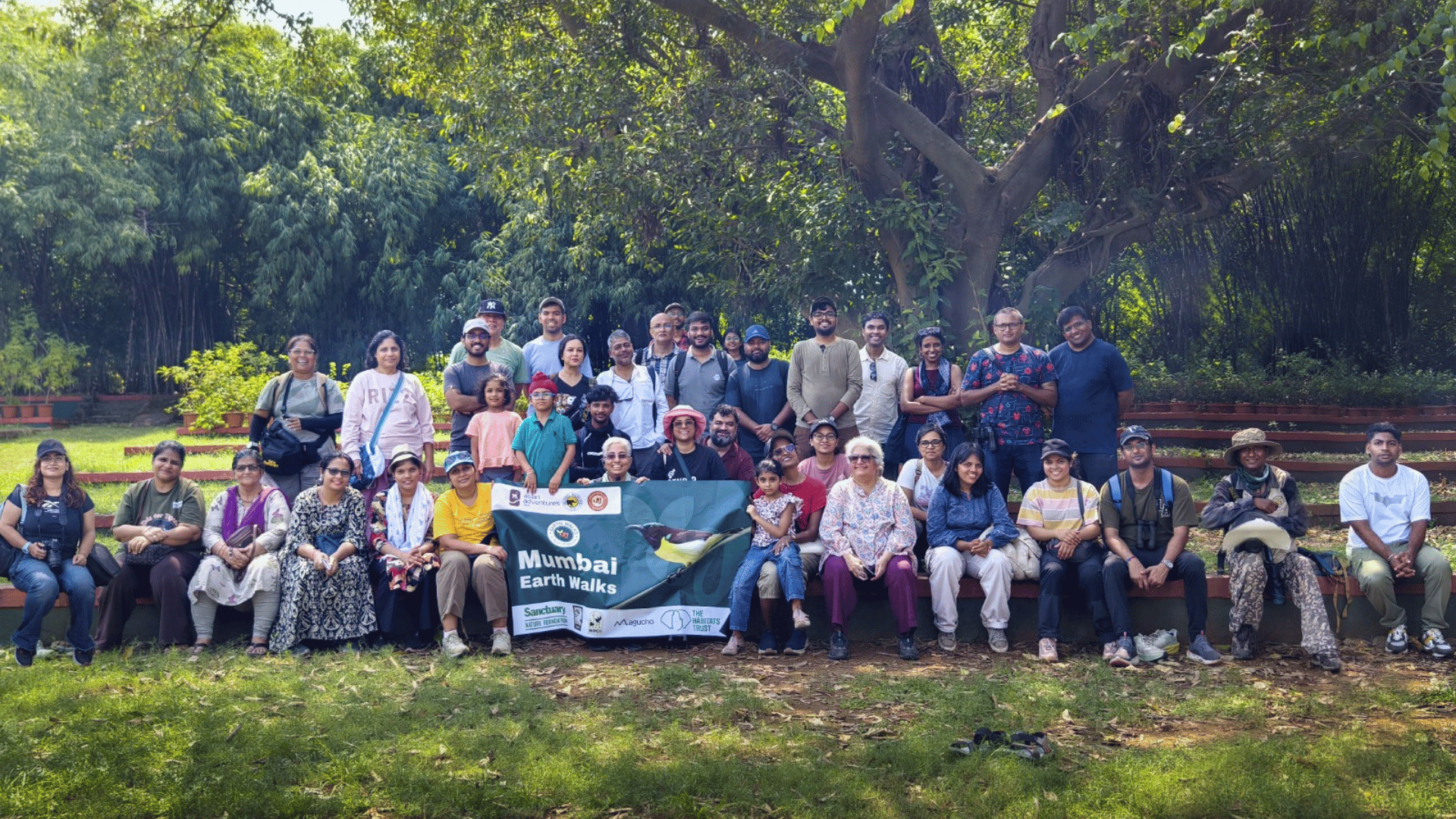
It was past 11 am, so we took our Group Photo under this beautiful, spreading tree, protected here at Maharashtra Nature Park (tathas tu!!) and shared the contents of our snack boxes, chatting, getting to know each other, recounting the memorable moments of our walk, repeating and laughing again at Renee’s funny and memorable anecdotes. Renee has a way of connecting facts about trees with mythology, fiction, Bollywood, popular songs, weaving them together, and - most of all- adding humour, so people relate and remember. Many people were touched by her passion for trees and simplicity and clarity of explanation, and asked for our Insta handles (which I shared). Phone numbers were exchanged, promises to keep in touch made, and while leaving, the big question on everyone's lips was: When is the next Earth Walk? To become a part of our next walk, https://asianadventures.info/p/af0725
Species spotted
1. Danaid Eggfly (Hypolimnas misippus) - Male; basking
2. Blues
3. White Orange-tip (Ixias marianne) - Nectaring
4. Yellow Orange-tip (Ixias pyrene)- Nectaring
5. Common Mormon (Papilio polytes) - Egg Laying, Nectaring
6. Lime Swallowtail (Papilio demoleus)- Nectaring
7. Common Jay (Graphium doson) - In flight
8. Common Shot Silverline (Cigaritis ictis)
9. Pioneer (Belenois aurota) - Nectaring
10. Common Gull (Cepora neriss)- Mud-puddling
11. Plain Tiger (Danaus chrysippus)- Mud-puddling
12. Emigrants (Common Emigrant/Mottled Emigrant - Catopsilia sp.)
13. Yellows (Eurema sp)